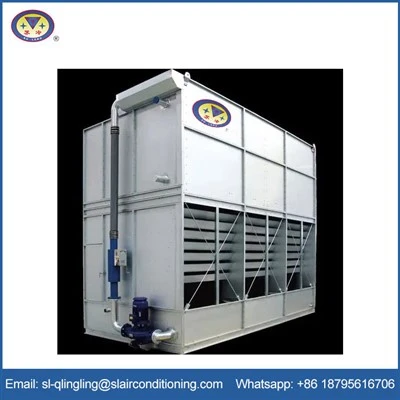
Hey there! As a supplier of evaporative condensers, I've dealt with all sorts of layout design challenges for multiple evaporative condensers. In this blog, I'm gonna share some tips on how to design the layout of multiple evaporative condensers, which'll hopefully help you make the most out of your setup.
1. Understand the Basics of Evaporative Condensers
Before diving into the layout design, it's crucial to have a solid grasp of how evaporative condensers work. Basically, an evaporative condenser uses the principle of evaporation to reject heat from a refrigerant system. The refrigerant releases heat as it condenses inside the condenser tubes, and this heat is transferred to the water film on the outside of the tubes. The water then evaporates, taking the heat away with it.
If you're interested in different types of related products, you can check out our Evaporative Industrial Air Cooler. It's a great option for many industrial cooling needs.
2. Consider the Space Available
The first thing you need to do when designing the layout of multiple evaporative condensers is to take a good look at the available space. You gotta measure the area where you plan to install the condensers, considering both the floor space and the vertical clearance.
If the space is limited, you might have to get creative with the arrangement. For example, you could stack the condensers vertically if the structure can support the weight. However, keep in mind that stacking might affect the airflow and maintenance access. On the other hand, if you have a large open area, you have more flexibility in terms of the layout. You can arrange the condensers in rows or clusters, depending on other factors like the piping layout and the airflow patterns.
3. Analyze the Airflow Requirements
Proper airflow is essential for the efficient operation of evaporative condensers. When designing the layout, you need to ensure that there's enough fresh air intake and exhaust for each condenser.
For fresh air intake, make sure there are no obstructions around the condensers. The intake area should be free from debris, vegetation, and other equipment that could block the airflow. You also need to consider the direction of the prevailing wind. Placing the condensers in a way that takes advantage of the natural wind can improve the cooling efficiency.
As for the exhaust, you need to prevent the hot, moist air from being recirculated back into the intake of the same or other condensers. This can be achieved by providing sufficient spacing between the condensers and ensuring that the exhaust is directed away from the intake areas. You might also need to install baffles or ducting to control the airflow and prevent recirculation.
4. Evaluate the Piping Layout
The piping layout is another important aspect of the multiple evaporative condenser design. You need to connect the condensers to the refrigerant system and the water supply and drainage systems.
When designing the piping, try to keep the lengths as short as possible to minimize the pressure drop. Use the appropriate pipe sizes to ensure proper flow rates. You also need to consider the flexibility of the piping to accommodate any thermal expansion or contraction.


If you're worried about the cost associated with the condenser system, check out our Air Conditioner Condenser Cost page for more information.
5. Plan for Maintenance and Accessibility
Maintenance is a key factor in the long - term performance of evaporative condensers. You need to design the layout in a way that allows easy access to all parts of the condensers for inspection, cleaning, and repair.
Leave enough space around the condensers for technicians to move freely. Provide walkways and platforms if necessary. Make sure that the access doors and panels are easily reachable and that there's enough clearance to remove any components that might need to be replaced.
6. Account for Noise and Vibration
Evaporative condensers can generate noise and vibration during operation. When designing the layout, you need to consider the impact of these factors on the surrounding environment and other equipment.
You can reduce the noise by installing sound - absorbing materials around the condensers or by placing them in a sound - insulated enclosure. To minimize vibration, use proper mounting techniques and vibration isolators. Make sure that the condensers are installed on a stable foundation to prevent excessive movement.
7. Think about Future Expansion
It's always a good idea to plan for future expansion when designing the layout of multiple evaporative condensers. You might need to add more condensers in the future to meet the growing cooling demands.
Leave some extra space in the layout for potential expansion. Also, design the piping and electrical systems in a way that can easily accommodate additional condensers. This will save you time and money in the long run.
8. Coordinate with Other Systems
Evaporative condensers are usually part of a larger HVAC or industrial cooling system. You need to coordinate the layout design with other systems such as pumps, chillers, and control systems.
Make sure that the location of the condensers doesn't interfere with the operation of other equipment. Also, ensure that the control systems can communicate effectively with all the condensers to maintain optimal performance.
Conclusion
Designing the layout of multiple evaporative condensers is a complex task that requires careful consideration of many factors. By understanding the basics of evaporative condensers, considering the available space, airflow requirements, piping layout, maintenance accessibility, noise and vibration, future expansion, and coordination with other systems, you can create an efficient and effective layout.
If you're in the market for evaporative condensers or need more advice on layout design, feel free to reach out to us. We're here to help you make the best decision for your cooling needs. And if you're interested in a condenser for a water cooler, check out our Condenser for Water Cooler page.
References
- ASHRAE Handbook of HVAC Systems and Equipment
- Manufacturer's guidelines for evaporative condensers
- Industry best practices for industrial cooling system design