


Evaporative Condenser
Why Choose Us?
Quality Control
Our production process is visualized, every production process can be show the video for check. After production, we accept all kinds of high stringent control quality inspection.
Competitive Pricing
The companyprovides customers with competitive pricing on its products without compromising their quality.
Professional Team
All the staff of Su Leng enterprises said to new and old friends: "Your satisfaction is our pursuit", we will provide you with intentions and professional services.
Sustainability
We are committed to environmental sustainability and strive to minimize our environmental impact by using eco-friendly production methods.
Definition of Evaporative Condenser
The evaporative condenser has a cabinet with a water-sprayed condenser, and it usually has one or more fans. The excess heat is removed by evaporating water. In an evaporative condenser the primary coolant of the cooling system is cooled, which is the opposite of a cooling tower. Evaporator condensers are more expensive than dry coolers and are primarily used in large cooling systems or systems where the outdoor temperature is high.


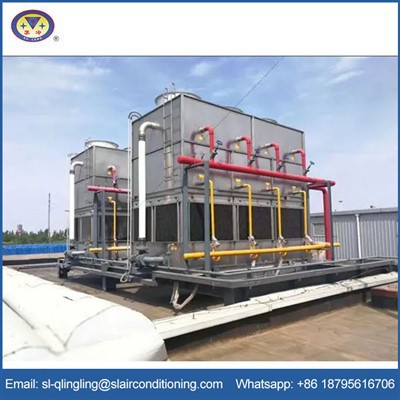


Benefits of Evaporative Condenser
The evaporative condenser is one of the main heat exchange equipment in the refrigeration system, and its function is to cool down the high temperature superheated refrigerant vapor discharged from compressor into liquid.
Water saving
Evaporative condenser makes full use of the latent heat of vaporization of water. The general water-cooled condenser can take 16.75 ~ 25.12KJ of 1Kg of water, while the evaporation of 1Kg of water can take about 2428KJ of heat at room temperature. Therefore the theoretical water consumption of evaporative condenser is only 1% of the water cooled condenser, and taking the splash damage, sewage and other factors into account, the actual water consumption of evaporative condenser is about 5% ~ 10% of the water-cooled condenser. Evaporative condenser has greatly reduced the loss of water, which is of great significance for the serious shortage of water resources in some regions.
Energy saving
The capacity of air-cooled condenser is limited to the ambient dry bulb temperature, while the evaporative condenser is limited to the environment of the ambient wet bulb temperature. Wet bulb temperature is lower 8 to 14 degrees Celsius than dry bulb temperature, and adding the negative pressure environment caused by the upper side of the fan to the device, so compared with air-cooled condenser, temperature of evaporative condenser is lower. As the condensing temperature increasing 1 degree, the power consumption of the unit cooling capacity will increase by 3% ~ 3.5%, so the total power consumption of the evaporative condenser will be significantly reduced, with obvious energy-saving effect. In the HVAC system, with respect to other cooling condenser, evaporative condenser can save 20% ~ 40% of the energy.
Compact structure
Because of no need of cooling tower, the whole device has the features of compact structure, small volume, small floor space, convenient installation, small daily maintenance workload.
No polluting environment
Many chemical plants in the past adopt shell tube type or spray type condenser. Because of the high condensation pressure, they usually use venting pressure. But the released gas is not incoagulable gas which contains a large number of ammonia. However, this phenomenon does not exist after using evaporative condenser.

Evaporative condensers use the cooling effect of evaporation to improve the heat rejection process. Water is sprayed over the condensing coil from above while air is simultaneously blown up through the coil from below to naturally lower the condensing temperature. The lower condensing temperature reduces the compressor workload.
As a result, your system operates more efficiently and uses far less energy than air cooled alternatives. In fact, the reduced compressor kW draw (25-30%) coupled with demand charge savings (up to 30% of a utility bill in some cases) can result in operating cost savings of more than 40% versus air cooled condensers.
Example of an Evaporative Condenser
The typical rooftop air conditioner is one type of evaporative condenser. In order to provide cooling for vast indoor spaces in commercial buildings like offices, shops, and restaurants, rooftop air conditioners are frequently employed. These devices frequently include an integrated evaporative condenser. Efficient condensing of the refrigerant vapor and heat release into the environment is accomplished by the evaporative condenser. It functions by combining air and water to speed up the cooling process.
In a rooftop air conditioning unit, the evaporative condenser typically includes a heat exchanger coil, a water distribution system, fans or blowers, and a water collection basin. The hot refrigerant vapor from the compressor flows through the coil, which is wetted by water sprayed onto its surface. As air is drawn across the wetted coil by fans or blowers, the heat from the refrigerant vapor is transferred to the water, causing the vapor to condense into a liquid state.
The evaporated water from the coil absorbs heat from the refrigerant, and the resulting cooler liquid refrigerant is then circulated back into the system to provide cooling. The collected water in the basin is recirculated through the system to ensure continuous cooling and evaporation. Rooftop air conditioning units with evaporative condensers are popular due to their energy efficiency and space-saving design. They are especially beneficial in warm climates where the cooling demands are high, and water availability is abundant.
Applications of Evaporative Condenser
Evaporative condenser is applied in all kinds of refrigeration systems, including cold storage, central air conditioning, industrial refrigeration unit, ammonia refrigeration system, etc. Because of their efficiency, evaporative condensers are well-suited to an array of industrial applications. They are particularly common in processing industries. Food and dairy products such as tomato purees, milk, herbal extracts, gelatin, coconut water, and whey and milk proteins are all processed with the help of evaporative condensers. The same is true for chemicals such as dyes, ammonium nitrate, glycerin, sodium nitrate, paints, and pigments.
Evaporative condensers are also ideal for very low temperature applications in the food and pharmaceutical industries. These include the production of plasma, fermented products, coffee extracts, fruit juices, bulk drugs, glycerin, sweet water, yeast extract, and protein hydrolysate. Whey, gelatin, malt extracts, glucose, fructose, dextrose, sorbitol, and maltodextrin are all produced with evaporative condensers, as well.
Another field in which evaporative condensers are widely used is waste management. Waste management providers rely on them to treat effluents, or wastewater, from various plants, including distilleries, grain mills, abattoirs, textile plants, chemical reactors, and storage tanks. Designed to serve a variety of practical uses, evaporative condensers are a versatile solution to many common industrial challenges.
What are the common issues or problems that can occur with an evaporative condenser and how can they be resolved?
An evaporative condenser can encounter a variety of issues. First off, scale formation is a common predicament, caused by the accumulation of minerals in the water. This build-up can lead to decreased efficiency and a higher risk of equipment failure. To combat this, regular water treatment and condenser cleaning are vital.
Another problem you might come across is algae growth, which not only affects the condenser's performance but can also cause health concerns. Algae thrive in moist environments like condensers so it's crucial to maintain proper hygiene and use effective biocontrols.
Overheating is another frequent issue, which can lead to system shutdowns. This often stems from poor maintenance or improper installation. Regular checks, ensuring the condenser is properly installed, and routine maintenance can help prevent this.
It's also not uncommon for evaporative condensers to suffer from water and refrigerant leaks due to wear and tear or faulty components. Regular checks can help detect these early and fix them before they escalate.
Inadequate air circulation, mainly due to blockages or fan issues, can also affect the condenser's performance. To resolve this, make sure to keep the air pathways clear and check the fan regularly.
Finally, cold weather can cause freeze-ups, resulting in system damage. Proper winterization of the system can prevent this.
When shopping for an evaporative condenser for your refrigeration system, there are several key factors to consider.
- First and foremost, you must look at the evaporative condenser's capacity. It's essential to choose a condenser that meets your system's specific cooling demands.
- Consider the evaporative condenser's energy efficiency. An energy-efficient model will not only reduce your carbon footprint but also save you money on utility bills in the long run. Look for models with energy-saving features such as variable speed fans or high-efficiency coils.
Weigh the material and build quality of the evaporative condenser. Opt for durable materials like stainless steel that can resist corrosion and withstand harsh weather conditions. Moreover, the design should allow for easy maintenance and cleaning to ensure optimal performance and longevity.
Evaluate the evaporative condenser's noise level. While this may seem trivial, a quiet unit makes for a more pleasant working environment, especially if the system is located near workspaces or residential areas.
Don't underestimate the importance of choosing a trusted manufacturer. Reliable manufacturers will provide comprehensive warranty coverage, and their products are more likely to offer superior performance and durability.
The Difference Between a Cooling Tower and an Evaporative Condenser
A cooling tower is a device that cools water by passing it through a series of metal pipes. The water is cooled by the evaporation of water in the pipes. An evaporative condenser is an air-cooled heat exchanger that uses the process of evaporative cooling to remove heat from a fluid.
A cooling tower is different from an evaporative condenser because it cools water by evaporation, while an evaporative condenser removes heat from a fluid using the process of evaporation.
A cooling tower is a device that cools water by the evaporation of water. A cooling tower operates by drawing air across the wet cooling coils or fins, causing a decrease in the temperature of the air and hence its relative humidity. An evaporative condenser is a heat rejection process where a vapor is condensed to liquid by contact with a cooler surface, without first passing through the liquid state. The process of condensation removes heat from the fluid stream and converts it into sensible energy.
A cooling tower can be used to cool water in applications such as power plants, industrial facilities, and large office buildings. An evaporative condenser can be used for many different applications such as refrigeration systems, air conditioning systems, and building ventilation systems.
Which Is Better Evaporative Condenser or Air-Cooled Condenser?
A refrigeration system needs a condenser in some form or another. Traditionally, the application of an air cooled condenser was preferred for small to medium installations, with evaporative condensers the preferred choice for medium to large installations. It is not possible to offer a definitive answer to which option is best, as there are many different aspects to consider in terms of performance and choice.
Evaporative condensers
The application of water cooled systems has been used for many years and is notably prevalent on larger industrial installations. There are a number of advantages to selecting a water cooled condenser.
It has been argued that they have better energy efficiency compared to air cooled condensers. This is due to the more efficient transfer of heat, leading to savings on energy costs and consumption. In addition to this, there are fewer exposed parts with evaporative condensers which makes them less vulnerable – making the case for their longer lifespan and the less frequent need for replacement. Evaporative condensers are also praised for their operational performance in higher temperature environments.
When installing refrigeration equipment, the footprint of the pad, plant room or enclosure will impose on a client's available space. Evaporative condensers don't have the need for plenty of fresh air to operate correctly and can be sited (within reason) anywhere. From an external environment perspective there is the advantage of having a quieter operation. Evaporative condensers don't have the ducts and vents of an air cooled condenser so there is not the same concern over noise pollution.
Air cooled condensers
There are a number of specific advantages to the use of air cooled condensers. Typically air cooled condensers are a more cost-effective option to install and maintain compared to water cooled condensers in their standard smaller configurations. When looking at smaller installations, the choice of an air cooled condenser tends to be favoured offering a wider application for their use. They also provide more options for refrigeration systems at the design phase of a project. A good example of this is the increased use of packaged chillers on many industrial refrigeration applications. The knock-on effect for this kind of system is the benefit to both installation programme reduction and commissioning time on site.
Air cooled condensers don't rely on a water to cool and so are not restricted by water availability. Also, due to the need for fewer parts, the risk of breakdown is reduced which means less on-going maintenance costs. This in turn leads to less downtime and greater reliability of the plant. Maintenance plays an extremely important part of any refrigeration system so this cannot be overlooked when making an important capital decision.
Our Factory
Yixing jiangnan refrigeratory air-conditioning equipment co.,ltd is specialized in producing and other cold storage and refrigeration equipment enterprises. Since the establishment of the factory in 1995, the hardworking and simple Jiangnan people have worked together, worked hard, innovated pragmatical, opened up the market and developed steadily. Over the past 20 years, the company has expanded the scale of enterprises three times and has complete processing and production equipment.
The company produced "Su Leng" brand SL series evaporative condenser, KL series air cooler, DDF series air cooler, DLM series manual, electric cold storage door, was rated as "Quality products in Jiangsu Province";the "Su Leng brand" cold storage door case products produced by the company were assessed by the "China Market Brand Strategic Management Association" as "China's top ten cold storage door sales brand"
Since the establishment of the factory in 1995, the hardworking and simple Jiangnan people have worked together, worked hard, innovated pragmatical, opened up the market and developed steadily. All the staff of Su Leng enterprises said to new and old friends: "Your satisfaction is our pursuit", we will provide you with intentions and professional services.
