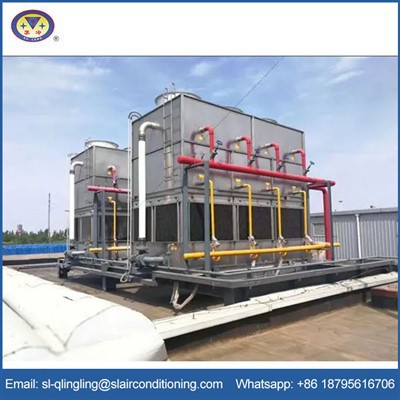
As a supplier of evaporative condensers, I've witnessed firsthand the remarkable energy - saving capabilities of these advanced systems compared to other condensers. In this blog, I'll delve into the science behind evaporative condensers and explain how they outperform their counterparts in terms of energy efficiency.
Understanding the Basics of Condensers
Before we compare the energy - saving aspects, let's briefly understand what condensers are. A condenser is a crucial component in refrigeration and air - conditioning systems. Its main function is to convert a vapor (usually a refrigerant) into a liquid by removing heat from it. There are several types of condensers, including air - cooled condensers, water - cooled condensers, and evaporative condensers.
Air - Cooled Condensers
Air - cooled condensers, also known as Air Condenser Unit, use ambient air to cool the refrigerant. A fan blows air over a series of tubes containing the hot refrigerant vapor. As the air absorbs the heat from the refrigerant, the refrigerant condenses into a liquid. However, air has a relatively low heat - carrying capacity. This means that to achieve the necessary cooling, large fans are often required to move a significant volume of air. These fans consume a considerable amount of electricity, especially in large - scale industrial or commercial applications.
Water - Cooled Condensers
Water - cooled condensers, like the Condenser for Water Cooler, use water as the cooling medium. Water has a much higher heat - carrying capacity than air, so it can remove heat from the refrigerant more efficiently. But water - cooled systems have their own set of challenges. They require a continuous supply of water, which can be a scarce resource in some regions. Additionally, a cooling tower is often needed to cool the water after it has absorbed heat from the refrigerant. The pumps and fans associated with the cooling tower consume a significant amount of energy.
How Evaporative Condensers Work
Evaporative condensers combine the best of both worlds by using both air and water for cooling. The process starts with the hot refrigerant vapor entering the condenser tubes. At the same time, water is sprayed over the outside of these tubes. A fan then draws air through the condenser, causing the water on the tube surface to evaporate.
Evaporation is a phase - change process that requires a large amount of heat energy, known as the latent heat of vaporization. As the water evaporates, it absorbs a substantial amount of heat from the refrigerant in the tubes, causing the refrigerant to condense into a liquid. The evaporated water is then carried away by the air stream, and the remaining water is recirculated back to the spray nozzles.
Energy - Saving Mechanisms of Evaporative Condensers
1. Higher Heat Transfer Efficiency
The combination of water evaporation and air movement in evaporative condensers results in a much higher heat transfer coefficient compared to air - cooled condensers. This means that evaporative condensers can transfer heat more effectively with a smaller temperature difference between the refrigerant and the cooling medium. As a result, less energy is required to achieve the same level of cooling.
For example, in a large industrial refrigeration system, an air - cooled condenser might need to run its fans at full speed for long periods to maintain the required refrigerant temperature. In contrast, an evaporative condenser can achieve the same cooling effect with less air movement and water circulation, thanks to its superior heat transfer properties.
2. Reduced Fan and Pump Power
Compared to air - cooled condensers, evaporative condensers can use smaller fans because the water evaporation significantly enhances the cooling process. The water also acts as a lubricant for the air flow, reducing the resistance and thus the power required to move the air.
In the case of water - cooled condensers, the need for a large - scale cooling tower and its associated pumps is eliminated in evaporative condensers. The recirculation of water within the evaporative condenser system is much more energy - efficient than the continuous flow of water in a water - cooled system with a cooling tower.
3. Lower Operating Temperatures
Evaporative condensers can maintain lower operating temperatures compared to air - cooled condensers. This is because the evaporation process can cool the refrigerant to a temperature closer to the wet - bulb temperature of the ambient air, which is typically lower than the dry - bulb temperature used by air - cooled condensers. Lower operating temperatures mean that the compressor in the refrigeration or air - conditioning system has to work less hard, resulting in significant energy savings.
Real - World Energy Savings
Let's look at some real - world examples to illustrate the energy - saving potential of evaporative condensers. In a commercial supermarket refrigeration system, an air - cooled condenser might consume around 30 - 40% of the total system energy. By replacing it with an evaporative condenser, energy consumption can be reduced by up to 50%. This not only results in lower electricity bills but also reduces the overall carbon footprint of the business.
In an industrial manufacturing plant, the energy savings can be even more substantial. A water - cooled condenser system with a cooling tower can be quite energy - intensive, especially in hot and dry climates. An evaporative condenser can cut down the energy consumption related to the cooling process by 40 - 60%, depending on the specific operating conditions.
Cost Considerations
When considering the cost of a condenser, the Air Conditioner Condenser Cost is an important factor. While the initial investment in an evaporative condenser might be slightly higher than that of an air - cooled condenser, the long - term energy savings more than make up for the difference. Over the lifespan of the system, the reduced energy consumption can lead to significant cost savings, making evaporative condensers a cost - effective choice in the long run.
Conclusion
In conclusion, evaporative condensers offer a highly efficient and energy - saving solution for refrigeration and air - conditioning systems. Their ability to combine the cooling effects of water evaporation and air movement results in superior heat transfer, reduced fan and pump power, and lower operating temperatures. These factors translate into significant energy savings and cost benefits for users.
If you're in the market for a new condenser or looking to upgrade your existing system, I encourage you to consider an evaporative condenser. Our company offers a wide range of high - quality evaporative condensers that are designed to meet the diverse needs of different industries. We're committed to providing energy - efficient solutions that not only save you money but also contribute to a more sustainable future. Contact us today to discuss your specific requirements and explore how our evaporative condensers can benefit your business.


References
- ASHRAE Handbook - Refrigeration. American Society of Heating, Refrigerating and Air - Conditioning Engineers.
- Stoecker, W. F., & Jones, J. W. (1982). Refrigeration and Air Conditioning. McGraw - Hill.
- “Energy - Efficient Refrigeration Systems” by the U.S. Department of Energy.