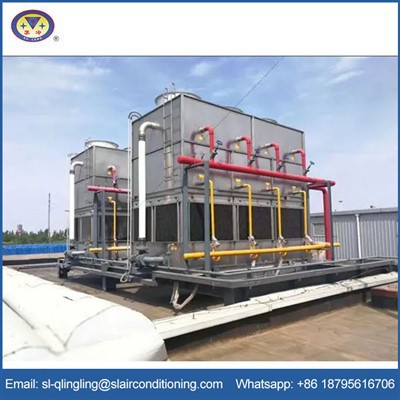
As a supplier of evaporative condensers, one of the most common questions I receive from customers is how to select the appropriate refrigerant for an evaporative condenser. This decision is crucial as it directly impacts the efficiency, performance, and environmental impact of the system. In this blog post, I will share some insights and considerations to help you make an informed choice.
Understanding the Basics of Refrigerants
Refrigerants are substances used in refrigeration and air - conditioning systems to transfer heat. They work by undergoing a phase change from a liquid to a vapor and back again, absorbing heat during evaporation and releasing it during condensation. When it comes to evaporative condensers, the refrigerant plays a vital role in the heat - transfer process.
There are several types of refrigerants available in the market, each with its own unique properties. The most commonly used refrigerants can be classified into the following categories:
Chlorofluorocarbons (CFCs)
CFCs were once widely used in refrigeration systems due to their excellent thermodynamic properties. However, they have been phased out because of their high ozone - depletion potential (ODP). For example, R - 11 and R - 12 are well - known CFCs that are no longer in use.
Hydrochlorofluorocarbons (HCFCs)
HCFCs were developed as a transitional alternative to CFCs. They have a lower ODP compared to CFCs but still contribute to ozone depletion. R - 22 is a common HCFC that has been gradually phased out in many countries.
Hydrofluorocarbons (HFCs)
HFCs do not contain chlorine, so they have zero ODP. However, they have a high global warming potential (GWP). R - 134a and R - 410A are popular HFCs used in various refrigeration and air - conditioning applications.
Hydrofluoroolefins (HFOs)
HFOs are a new generation of refrigerants. They have low GWP and zero ODP, making them more environmentally friendly. R - 1234yf and R - 1234ze are examples of HFOs that are being increasingly adopted.
Factors to Consider When Selecting a Refrigerant
Environmental Impact
In today's world, environmental considerations are of utmost importance. When choosing a refrigerant for your evaporative condenser, you should look for substances with low ODP and GWP. As regulations become stricter, using environmentally friendly refrigerants can also help you avoid future compliance issues. For instance, many countries are implementing policies to reduce the use of high - GWP HFCs and promote the adoption of HFOs.
Thermodynamic Properties
The thermodynamic properties of a refrigerant, such as its boiling point, latent heat of vaporization, and specific heat, have a significant impact on the performance of the evaporative condenser. A refrigerant with a suitable boiling point at the operating conditions of the system will ensure efficient heat transfer. For example, if the refrigerant boils too easily at the condenser's operating pressure, it may not be able to effectively release heat.
Compatibility with System Materials
The refrigerant must be compatible with the materials used in the evaporative condenser and the rest of the refrigeration system. Some refrigerants can react with certain metals, elastomers, and plastics, leading to corrosion, leaks, or other system failures. For example, ammonia (R - 717) is a highly effective refrigerant, but it is corrosive to copper and brass, so systems using ammonia require special materials.
Safety
Safety is another crucial factor. Refrigerants can be flammable, toxic, or both. For example, some hydrocarbon refrigerants are flammable, and ammonia is toxic. When selecting a refrigerant, you need to ensure that the system can be designed and operated safely to prevent any potential hazards.
Cost
Cost is always a consideration in any business decision. The cost of the refrigerant itself, as well as the cost of system modifications, maintenance, and disposal, should be taken into account. Some new - generation refrigerants may be more expensive than traditional ones, but they may also offer long - term savings in terms of energy efficiency and environmental compliance.
Specific Refrigerants and Their Suitability for Evaporative Condensers
R - 410A
R - 410A is a widely used HFC refrigerant. It has a high cooling capacity and is suitable for medium - to high - temperature applications. It is commonly used in air - conditioning systems, including those with evaporative condensers. However, due to its relatively high GWP, there is a growing trend to replace it with more environmentally friendly alternatives.
R - 134a
R - 134a is another popular HFC refrigerant. It has a lower GWP compared to R - 410A and is often used in automotive air - conditioning and some commercial refrigeration systems. It is suitable for applications where a lower - pressure refrigerant is required.


R - 1234yf
R - 1234yf is an HFO refrigerant. It has a very low GWP and is being increasingly used as a replacement for R - 134a in automotive air - conditioning. It also shows promise for use in evaporative condensers, especially in applications where environmental performance is a priority.
Ammonia (R - 717)
Ammonia is a natural refrigerant with excellent thermodynamic properties. It has zero ODP and a very low GWP. It is commonly used in large - scale industrial refrigeration systems with evaporative condensers. However, as mentioned earlier, its toxicity and corrosiveness require careful system design and safety measures.
Our Evaporative Condenser Solutions
At our company, we offer a range of Evaporative Condensing Unit that can be customized to work with different refrigerants. Our experienced engineers can help you select the most suitable refrigerant for your specific application based on the factors mentioned above.
We also provide Air Condenser Unit and Airwell Water Cooled Condenser options, which can be integrated into your refrigeration system for optimal performance.
Conclusion
Selecting the appropriate refrigerant for an evaporative condenser is a complex decision that requires careful consideration of multiple factors. By taking into account environmental impact, thermodynamic properties, compatibility, safety, and cost, you can choose a refrigerant that will ensure the efficient and reliable operation of your system.
If you are in the process of selecting a refrigerant for your evaporative condenser or need more information about our products, we encourage you to contact us for a detailed discussion. Our team of experts is ready to assist you in making the best choice for your business.
References
ASHRAE Handbook - Refrigeration. American Society of Heating, Refrigerating and Air - Conditioning Engineers.
"Refrigerant Selection and Management for HVAC&R Systems." U.S. Environmental Protection Agency.
"Thermodynamic Properties of Refrigerants." International Institute of Refrigeration.