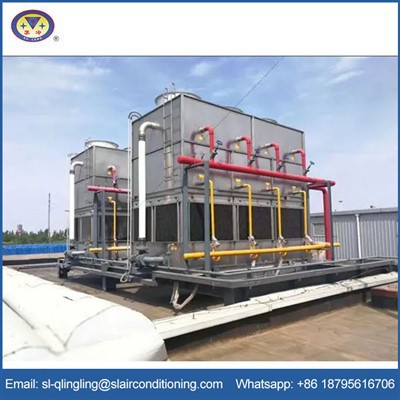
As a supplier of Evaporative Condensing Units, I'm often asked about how these units work within a heat pump system. In this blog, I'll delve into the science behind the operation of an Evaporative Condensing Unit in a heat pump system, explaining the key processes and components involved.
Understanding the Basics of a Heat Pump System
Before we dive into the Evaporative Condensing Unit, let's briefly review the basic principles of a heat pump system. A heat pump is a device that transfers heat from one location to another, either for heating or cooling purposes. It operates on the principle of the refrigeration cycle, which consists of four main components: the compressor, the condenser, the expansion valve, and the evaporator.
The compressor plays a crucial role in the refrigeration cycle. It compresses the refrigerant gas, raising its temperature and pressure. The high - pressure, high - temperature refrigerant then flows to the condenser.
The Role of the Condenser in a Heat Pump System
The condenser is responsible for releasing the heat absorbed by the refrigerant in the evaporator. In a heat pump system, when the system is in heating mode, the condenser releases heat into the indoor environment. When it's in cooling mode, the condenser expels heat to the outside.
This is where the Evaporative Condensing Unit comes in. It is a type of condenser that uses the process of evaporation to enhance the heat - rejection process.


How an Evaporative Condensing Unit Works
An Evaporative Condensing Unit combines the functions of a condenser and a cooling tower. It consists of several key components: a refrigerant coil, a water distribution system, a fan, and a sump.
Refrigerant Coil
The refrigerant coil is where the hot refrigerant from the compressor enters. As the refrigerant flows through the coil, it transfers its heat to the surrounding environment. The coil is designed to maximize the surface area available for heat transfer, which can be in the form of finned tubes.
Water Distribution System
The water distribution system sprays water over the refrigerant coil. The water forms a thin film on the outer surface of the coil. As the hot refrigerant inside the coil transfers heat to the water film, a portion of the water evaporates. Evaporation is a phase - change process that requires a significant amount of energy (latent heat of vaporization). This energy is taken from the heat of the refrigerant, effectively cooling it down.
Fan
The fan in the Evaporative Condensing Unit draws air through the coil. The moving air helps to carry away the water vapor that is produced during the evaporation process. It also promotes better heat transfer by increasing the airflow over the coil surface. The combination of the evaporating water and the moving air results in a highly efficient heat - rejection process.
Sump
The sump is located at the bottom of the unit. It collects the water that has not evaporated. A pump then recirculates the water back to the water distribution system for reuse. This closed - loop water system helps to conserve water and reduce operating costs.
Advantages of Using an Evaporative Condensing Unit in a Heat Pump System
High Efficiency
The use of evaporation in the heat - rejection process makes Evaporative Condensing Units more efficient than traditional air - cooled condensers. The latent heat of vaporization of water is much higher than the sensible heat transfer capacity of air. This means that more heat can be removed from the refrigerant with less energy input.
Energy Savings
Due to their high efficiency, Evaporative Condensing Units can significantly reduce the energy consumption of a heat pump system. This leads to lower operating costs over the long term, making them an attractive option for both commercial and industrial applications.
Space Savings
Compared to some other types of condensers, Evaporative Condensing Units can be more compact. They can achieve the same level of heat rejection in a smaller footprint, which is beneficial for installations where space is limited.
Applications of Evaporative Condensing Units in Heat Pump Systems
Evaporative Condensing Units are widely used in various heat pump applications. In commercial buildings, they can be used in large - scale HVAC systems to provide efficient heating and cooling. In industrial settings, they are often employed in processes that require precise temperature control, such as in food processing plants and pharmaceutical manufacturing facilities.
If you are interested in learning more about specific types of condensers, you can visit our pages: Industrial Water Condenser, Condenser for Water Cooler, and Airwell Water Cooled Condenser.
Maintenance and Considerations
Like any mechanical system, Evaporative Condensing Units require regular maintenance to ensure optimal performance. The water quality in the sump needs to be monitored and treated to prevent the growth of algae and bacteria. The coils should be inspected periodically for dirt and debris buildup, which can reduce the heat - transfer efficiency.
It's also important to consider the environmental conditions when installing an Evaporative Condensing Unit. The unit should be placed in an area with good air circulation and away from sources of contamination.
Conclusion
In conclusion, an Evaporative Condensing Unit is a vital component in a heat pump system. Its unique design and operation, based on the principle of evaporation, offer high - efficiency heat rejection, energy savings, and space - saving benefits. Whether you are in the commercial or industrial sector, an Evaporative Condensing Unit can enhance the performance of your heat pump system.
If you are interested in purchasing an Evaporative Condensing Unit for your heat pump system, we encourage you to reach out to us for a detailed discussion. Our team of experts can provide you with customized solutions based on your specific requirements.
References
- ASHRAE Handbook - HVAC Systems and Equipment. American Society of Heating, Refrigerating and Air - Conditioning Engineers.
- Refrigeration and Air Conditioning Technology. William C. Whitman, William M. Johnson, John Tomczyk, and Eugene Silberstein.