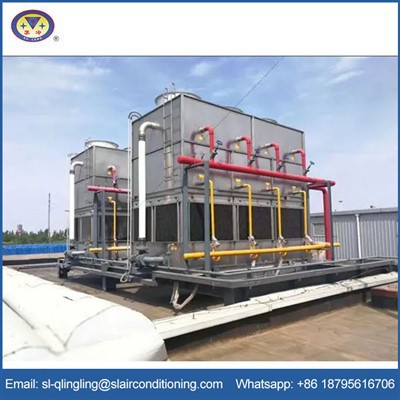
Hey there! As a supplier of Industrial Water Condenser, I've seen firsthand the importance of efficient heat transfer in industrial settings. In this blog, I'm gonna share some tips on how to enhance the heat transfer in industrial water condensers.
Understanding the Basics of Heat Transfer in Industrial Water Condensers
Before we dive into the tips, let's quickly go over how heat transfer works in industrial water condensers. Essentially, a condenser is a device that cools down a vapor and turns it back into a liquid. In an industrial water condenser, water is used as the cooling medium. The hot vapor comes into contact with the water, and heat is transferred from the vapor to the water.
There are three main modes of heat transfer: conduction, convection, and radiation. In industrial water condensers, conduction and convection play the most significant roles. Conduction occurs when heat is transferred through a solid material, like the tubes in a condenser. Convection, on the other hand, involves the movement of fluids (in this case, the vapor and the water) to transfer heat.
Tips to Enhance Heat Transfer
1. Optimize the Condenser Design
The design of the condenser has a huge impact on heat transfer efficiency. For starters, the tube arrangement matters. A well-designed tube layout can ensure that the vapor and water come into contact as effectively as possible. For example, using a staggered tube arrangement can increase the turbulence of the fluids, which in turn enhances heat transfer.


Also, the size and length of the tubes are crucial. Longer tubes generally provide more surface area for heat transfer, but they can also increase the pressure drop. So, it's a balancing act. You need to find the right combination of tube size and length for your specific application.
2. Maintain Proper Water Flow
Water flow is another key factor. You want to make sure that the water is flowing at the right rate through the condenser. If the water flow is too slow, the heat transfer will be inefficient because the water won't be able to carry away the heat fast enough. On the other hand, if the water flow is too fast, it can cause excessive pressure drop and increase energy consumption.
Regularly check the water flow rate using flow meters and adjust the pumps accordingly. Also, make sure that the water distribution in the condenser is uniform. Uneven water flow can lead to hot spots and reduced heat transfer efficiency.
3. Keep the Condenser Clean
Over time, dirt, scale, and other contaminants can build up on the surfaces of the condenser tubes. This buildup acts as an insulator and reduces the heat transfer rate. So, it's essential to keep the condenser clean.
You can use chemical cleaning methods to remove scale and debris. However, be careful with the chemicals you use, as some can damage the condenser materials. Another option is mechanical cleaning, such as using brushes or high-pressure water jets. Regular cleaning schedules can help prevent major buildup and keep the condenser operating at peak efficiency.
4. Use High - Performance Heat Transfer Fluids
In some cases, using a different heat transfer fluid than just plain water can improve heat transfer. There are various types of heat transfer fluids available, such as glycol - water mixtures. These fluids have different thermal properties compared to water, which can be beneficial in certain applications.
For example, glycol - water mixtures have a lower freezing point than water, which can be useful in cold environments. They also have different heat capacities and viscosities, which can affect heat transfer. However, make sure to choose the right fluid based on your specific requirements and consider factors like cost, compatibility with the condenser materials, and environmental impact.
5. Improve Vapor Distribution
Proper vapor distribution is just as important as water distribution. If the vapor is not evenly distributed across the condenser tubes, some tubes will receive more heat than others, leading to uneven heat transfer.
You can use baffles or other flow - directing devices to improve vapor distribution. These devices help guide the vapor to all parts of the condenser, ensuring that the heat transfer is more uniform.
Comparing Different Types of Condensers
Airwell Water Cooled Condenser
The Airwell Water Cooled Condenser is a popular choice in many industrial applications. It uses water as the cooling medium and is known for its relatively high heat transfer efficiency. The design of the Airwell condenser often includes features that promote good water and vapor distribution, which helps enhance heat transfer.
However, it does require a reliable water supply. If the water quality is poor or the water flow is interrupted, it can affect the performance of the condenser.
Air Condenser Unit
Air condenser units use air as the cooling medium instead of water. They are often more suitable for applications where water is scarce or where there are environmental concerns about water usage.
The heat transfer in air condenser units mainly relies on convection between the hot vapor and the air. While they are generally less efficient than water - cooled condensers in terms of heat transfer rate, they can be a good option in certain situations. For example, in dry climates or in applications where the heat load is relatively low.
Conclusion
Enhancing heat transfer in industrial water condensers is crucial for improving energy efficiency, reducing operating costs, and ensuring the smooth operation of industrial processes. By optimizing the condenser design, maintaining proper water flow, keeping the condenser clean, using high - performance heat transfer fluids, and improving vapor distribution, you can significantly improve the heat transfer rate.
Whether you're using an Industrial Water Condenser, an Airwell Water Cooled Condenser, or an Air Condenser Unit, these tips can help you get the most out of your condenser.
If you're in the market for a new condenser or looking to improve the performance of your existing one, don't hesitate to reach out. We're here to help you find the best solution for your specific needs and ensure that your industrial processes run as efficiently as possible. Let's start a conversation about how we can work together to enhance your heat transfer and boost your bottom line.
References
- Incropera, F. P., & DeWitt, D. P. (2002). Fundamentals of Heat and Mass Transfer. John Wiley & Sons.
- Bergman, T. L., Lavine, A. S., Incropera, F. P., & DeWitt, D. P. (2011). Introduction to Heat Transfer. John Wiley & Sons.