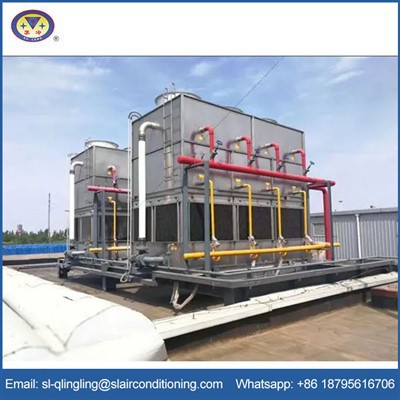
In the realm of industrial cooling systems, two prominent technologies stand out: evaporative condensers and chillers. As a leading supplier of evaporative condensers, I am often asked about the performance differences between these two solutions. In this blog post, I will delve into the key aspects of their performance, highlighting their strengths and limitations to help you make an informed decision for your cooling needs.
Energy Efficiency
One of the most critical factors in evaluating any cooling system is its energy efficiency. Energy consumption not only affects operational costs but also has environmental implications. Let's compare the energy efficiency of evaporative condensers and chillers.
Evaporative Condensers
Evaporative condensers operate on the principle of evaporative cooling, where water is sprayed over the condenser coils, and a fan draws air through the unit. As the water evaporates, it absorbs heat from the refrigerant in the coils, causing the refrigerant to condense. This process is highly efficient because it uses the latent heat of vaporization of water to remove heat, which requires less energy compared to other cooling methods.
The energy efficiency of an evaporative condenser is typically measured by its coefficient of performance (COP), which is the ratio of the cooling capacity to the power input. Evaporative condensers can achieve high COP values, especially in hot and dry climates, where the evaporation rate is high. Additionally, they can operate at lower condensing pressures compared to other types of condensers, further reducing energy consumption.
Chillers
Chillers are refrigeration systems that use a compressor to circulate a refrigerant through a closed-loop system. The refrigerant absorbs heat from the process or space being cooled and releases it to the environment through a condenser. Chillers can be either air-cooled or water-cooled.
Air-cooled chillers use ambient air to cool the condenser, which requires a significant amount of energy to drive the fans. In hot climates, the performance of air-cooled chillers can degrade as the ambient temperature increases, leading to higher energy consumption. Water-cooled chillers, on the other hand, use water to cool the condenser, which is more efficient than air-cooling. However, water-cooled chillers require a cooling tower to reject the heat from the water, which also consumes energy.
Overall, evaporative condensers are generally more energy-efficient than air-cooled chillers and can be comparable or more efficient than water-cooled chillers in certain applications. The exact energy savings will depend on factors such as the climate, the cooling load, and the operating conditions.
Cooling Capacity
Another important aspect of a cooling system is its cooling capacity, which refers to the amount of heat that the system can remove per unit of time. The cooling capacity required for a particular application depends on factors such as the size of the space or process being cooled, the heat load, and the desired temperature.
Evaporative Condensers
Evaporative condensers are available in a wide range of sizes and capacities, making them suitable for various industrial applications. They can provide high cooling capacities, especially in large-scale operations, such as power plants, refineries, and industrial factories. The cooling capacity of an evaporative condenser can be adjusted by controlling the flow rate of the water and the air, allowing for precise temperature control.
Chillers
Chillers are also available in different sizes and capacities, ranging from small domestic units to large industrial systems. The cooling capacity of a chiller is determined by the size of the compressor, the refrigerant used, and the design of the condenser and evaporator. Chillers can provide high cooling capacities, but they may require more space and equipment compared to evaporative condensers.
In general, the cooling capacity of an evaporative condenser and a chiller can be comparable, but the choice between the two will depend on the specific requirements of the application. Evaporative condensers are often preferred for high-temperature applications and large cooling loads, while chillers may be more suitable for applications that require precise temperature control and low-temperature operation.
Water Consumption
Water consumption is an important consideration in industrial cooling systems, especially in regions where water is scarce. Let's compare the water consumption of evaporative condensers and chillers.
Evaporative Condensers
Evaporative condensers use water as a cooling medium, and a significant amount of water is lost through evaporation. However, modern evaporative condensers are designed to minimize water consumption by using advanced water management systems, such as water recycling and reuse. These systems can reduce water consumption by up to 90% compared to traditional evaporative condensers.
Chillers
Air-cooled chillers do not use water for cooling, so they have zero water consumption. Water-cooled chillers, on the other hand, require a continuous supply of water to cool the condenser. The amount of water consumed by a water-cooled chiller depends on factors such as the cooling load, the efficiency of the cooling tower, and the operating conditions. In general, water-cooled chillers consume more water than evaporative condensers, but the exact amount will vary depending on the specific system.
Overall, evaporative condensers can be designed to be water-efficient, and with proper management, they can consume less water than water-cooled chillers. However, the choice between the two will depend on the availability of water and the specific requirements of the application.
Maintenance and Reliability
Maintenance and reliability are crucial factors in ensuring the long-term performance of a cooling system. Let's compare the maintenance requirements and reliability of evaporative condensers and chillers.
Evaporative Condensers
Evaporative condensers require regular maintenance to ensure optimal performance. This includes cleaning the condenser coils, checking the water quality, and maintaining the water distribution system. The frequency of maintenance will depend on factors such as the operating conditions, the water quality, and the type of evaporative condenser.


In general, evaporative condensers are relatively reliable and have a long service life. However, they may be more susceptible to corrosion and scaling, especially in areas with high water hardness. To prevent these issues, it is important to use proper water treatment and maintenance procedures.
Chillers
Chillers also require regular maintenance to ensure optimal performance. This includes checking the refrigerant levels, cleaning the condenser and evaporator coils, and servicing the compressor. The frequency of maintenance will depend on factors such as the operating conditions, the type of chiller, and the manufacturer's recommendations.
In general, chillers are reliable and have a long service life. However, they may be more complex and expensive to maintain compared to evaporative condensers. Additionally, the compressor in a chiller is a critical component that can be prone to failure, which can result in costly downtime.
Overall, both evaporative condensers and chillers require regular maintenance to ensure optimal performance and reliability. The choice between the two will depend on factors such as the operating conditions, the level of maintenance required, and the budget.
Cost
Cost is often a major consideration when choosing a cooling system. Let's compare the initial cost and operating cost of evaporative condensers and chillers.
Evaporative Condensers
The initial cost of an evaporative condenser is generally lower than that of a chiller. This is because evaporative condensers are simpler in design and require less equipment compared to chillers. Additionally, the installation cost of an evaporative condenser is usually lower because it does not require a separate cooling tower.
The operating cost of an evaporative condenser is mainly determined by the energy consumption and the water consumption. As mentioned earlier, evaporative condensers are generally more energy-efficient and can be designed to be water-efficient, which can result in lower operating costs compared to chillers.
Chillers
The initial cost of a chiller is generally higher than that of an evaporative condenser. This is because chillers are more complex in design and require more equipment, such as a compressor, a condenser, and an evaporator. Additionally, the installation cost of a chiller is usually higher because it may require a separate cooling tower and other auxiliary equipment.
The operating cost of a chiller is mainly determined by the energy consumption and the maintenance cost. As mentioned earlier, chillers can be energy-intensive, especially in hot climates, which can result in higher operating costs compared to evaporative condensers. Additionally, the maintenance cost of a chiller is usually higher because it is more complex and requires more frequent servicing.
Overall, the choice between an evaporative condenser and a chiller will depend on factors such as the initial budget, the operating cost, and the specific requirements of the application. In general, evaporative condensers are more cost-effective for large-scale applications and high-temperature operations, while chillers may be more suitable for applications that require precise temperature control and low-temperature operation.
Conclusion
In conclusion, both evaporative condensers and chillers have their strengths and limitations, and the choice between the two will depend on the specific requirements of the application. Evaporative condensers are generally more energy-efficient, have a higher cooling capacity, and can be designed to be water-efficient. They are also relatively simple in design and require less maintenance compared to chillers. On the other hand, chillers can provide precise temperature control and are suitable for low-temperature applications. However, they are more complex and expensive to install and maintain, and they can be energy-intensive, especially in hot climates.
As a supplier of evaporative condensers, I am confident that our products can provide a cost-effective and energy-efficient cooling solution for your industrial applications. Our evaporative condensers are designed and manufactured to the highest standards, using the latest technology and materials. We offer a wide range of models and configurations to meet your specific requirements, and our team of experts can provide you with professional advice and support throughout the entire process.
If you are interested in learning more about our Industrial Water Condenser, Water Cooled Condensing Unit, or Water Cooled Refrigeration Condenser, or if you have any questions or concerns about your cooling needs, please do not hesitate to contact us. We look forward to working with you to provide the best cooling solution for your business.