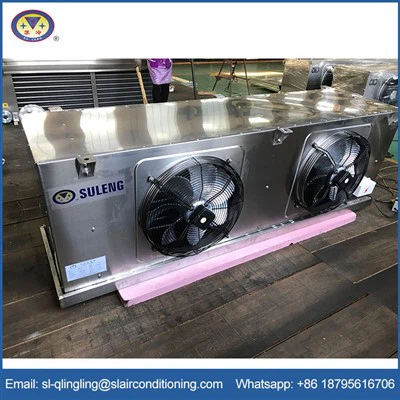
As an industrial cooler supplier, I've had the privilege of witnessing firsthand the stark differences between industrial coolers and domestic coolers. These differences span various aspects, from design and functionality to performance and application scenarios. In this blog post, I'll delve into these disparities to help you understand which type of cooler is best suited for your needs.
Design and Construction
Industrial coolers are built to withstand harsh industrial environments and heavy usage. They are typically larger and more robust than domestic coolers. The materials used in industrial coolers are often of higher quality and durability to ensure long - term operation. For example, the casing of an industrial cooler may be made of heavy - gauge steel or aluminum, which can resist corrosion, impacts, and extreme temperatures.
On the other hand, domestic coolers are designed with a focus on aesthetics and space - saving. They are usually smaller in size and come in a variety of sleek designs to blend in with home decor. The casings are often made of plastic or lightweight metal, which is sufficient for the relatively mild home environment.


The internal components also differ significantly. Industrial coolers often feature larger and more powerful compressors, condensers, and evaporators. These components are designed to handle large volumes of air and provide high - capacity cooling. In contrast, domestic coolers have smaller and less powerful components, as they only need to cool a limited space, such as a single room or a small area.
Cooling Capacity
One of the most significant differences between industrial and domestic coolers is their cooling capacity. Industrial coolers are designed to cool large spaces, such as factories, warehouses, and commercial kitchens. They can provide a high level of cooling power, measured in British Thermal Units (BTUs). For instance, an industrial cooler may have a cooling capacity of 50,000 BTUs or more, which is sufficient to cool a large area quickly.
Domestic coolers, on the other hand, are designed for much smaller spaces. They typically have a cooling capacity ranging from 5,000 to 15,000 BTUs, which is suitable for cooling a bedroom, living room, or office. If you try to use a domestic cooler in an industrial setting, it will be overwhelmed and unable to provide the necessary cooling.
Energy Efficiency
Energy efficiency is an important consideration for both industrial and domestic users. Industrial coolers, despite their large size and high cooling capacity, are designed to be energy - efficient. Many industrial coolers use advanced technologies, such as variable - speed compressors and intelligent control systems, to optimize energy consumption. These technologies allow the cooler to adjust its cooling output based on the actual cooling demand, reducing energy waste.
Domestic coolers also focus on energy efficiency, but to a different extent. They are often equipped with energy - saving features, such as programmable thermostats and sleep modes. However, due to their smaller size and less complex systems, the energy - saving potential of domestic coolers is generally lower than that of industrial coolers.
Noise Level
Noise can be a major concern, especially in domestic settings. Domestic coolers are designed to operate quietly, with noise levels typically ranging from 40 to 60 decibels. This level of noise is similar to the sound of a normal conversation, which is not overly disruptive in a home environment.
Industrial coolers, however, tend to be noisier. The large motors and high - capacity fans used in industrial coolers generate more noise, often exceeding 70 decibels. In industrial settings, this noise is usually less of a concern, as the ambient noise level is already relatively high. However, in some cases, additional noise - reduction measures may be required.
Application Scenarios
Industrial coolers are used in a wide range of industrial applications. In manufacturing plants, they are used to cool machinery and equipment, preventing overheating and ensuring smooth operation. In cold storage facilities, Industrial Cooler are essential for maintaining the proper temperature to preserve perishable goods. They are also used in commercial kitchens to keep food and beverages cold.
Domestic coolers are mainly used in homes and small offices. They provide a comfortable living and working environment by cooling individual rooms. For example, a Fast Cooling Cold Storage Air Cooler can be used in a bedroom to create a cool and relaxing atmosphere at night.
Maintenance and Service
Industrial coolers require more frequent and comprehensive maintenance than domestic coolers. Due to their large size and complex systems, industrial coolers need regular inspections, cleaning, and component replacements. Professional maintenance services are often required to ensure the proper functioning of industrial coolers.
Domestic coolers are generally easier to maintain. They usually only need basic cleaning, such as dusting the filters and checking the refrigerant levels. In most cases, homeowners can perform these maintenance tasks themselves.
Cost
The cost of industrial and domestic coolers also varies significantly. Industrial coolers are more expensive upfront due to their large size, high - capacity components, and advanced technologies. In addition, the installation and maintenance costs of industrial coolers are also higher.
Domestic coolers are much more affordable. They are available in a wide range of prices, depending on the brand, size, and features. For most homeowners, a domestic cooler is a cost - effective solution for cooling their homes.
Conclusion
In conclusion, industrial coolers and domestic coolers have distinct differences in design, cooling capacity, energy efficiency, noise level, application scenarios, maintenance, and cost. If you are in an industrial setting that requires high - capacity cooling, an Industrial Cooler is the right choice. On the other hand, if you need to cool a small space in your home or office, a domestic cooler will be sufficient.
If you are interested in our industrial coolers, including Fast Cooling Cold Storage Air Cooler and Cooler Ac Unit, please feel free to contact us for more information and to discuss your specific cooling needs. We are committed to providing high - quality products and excellent service to meet your requirements.