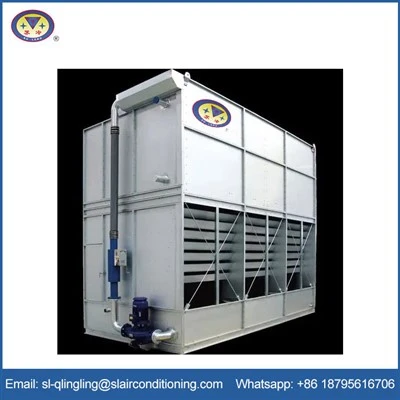
As a supplier of Water Condenser From Air, I've delved deep into the topic of energy - recovery methods for water condensers from air. These systems are crucial in various industries, from HVAC to industrial refrigeration. By recovering energy, we not only enhance the efficiency of the condenser but also contribute to environmental sustainability and cost - savings for our clients.
1. Heat Exchanger Systems
One of the most common energy - recovery methods for water condensers from air is the use of heat exchanger systems. Heat exchangers work by transferring heat from one fluid to another without the two fluids coming into direct contact. In the context of a water condenser from air, the hot refrigerant in the condenser can transfer its heat to a cooler fluid, such as water or a secondary refrigerant.
There are different types of heat exchangers that can be employed. Plate heat exchangers, for example, are known for their high efficiency and compact design. They consist of a series of thin plates that are stacked together, creating channels for the two fluids to flow through. The large surface area of the plates allows for efficient heat transfer. Another type is the shell - and - tube heat exchanger, which is more robust and suitable for high - pressure applications. It consists of a shell that houses a bundle of tubes. One fluid flows through the tubes, while the other flows around the tubes in the shell.
By using a heat exchanger, the heat that would otherwise be wasted can be recovered and used for other purposes. For instance, the recovered heat can be used to pre - heat water for industrial processes or for space heating in buildings. This reduces the need for additional energy sources, leading to significant cost savings.
2. Organic Rankine Cycle (ORC)
The Organic Rankine Cycle is another effective energy - recovery method. It is similar to the traditional Rankine cycle used in steam power plants, but instead of water, it uses an organic fluid with a lower boiling point. In the context of a water condenser from air, the waste heat from the condenser can be used to vaporize the organic fluid in the ORC system.
The vaporized organic fluid then expands through a turbine, generating mechanical energy. This mechanical energy can be converted into electrical energy using a generator. After passing through the turbine, the organic fluid is condensed back into a liquid and recirculated through the system.
The advantage of the ORC system is that it can operate at relatively low temperatures, making it suitable for recovering waste heat from water condensers from air. It can also be customized to fit different applications, depending on the amount of waste heat available and the power requirements. However, the initial investment for an ORC system can be relatively high, and it requires careful maintenance to ensure optimal performance.


3. Absorption Refrigeration Systems
Absorption refrigeration systems can also be used for energy recovery in water condensers from air. These systems use heat as the energy source instead of mechanical work, as in traditional vapor - compression refrigeration systems.
In an absorption refrigeration system, a refrigerant (usually ammonia or water) is absorbed by an absorbent (such as lithium bromide). The absorption process releases heat, which can be used for other purposes. The refrigerant - absorbent mixture is then heated, causing the refrigerant to vaporize. The vaporized refrigerant is then condensed, and the cycle repeats.
By integrating an absorption refrigeration system with a water condenser from air, the waste heat from the condenser can be used to drive the absorption process. This not only recovers the waste heat but also provides additional cooling capacity if needed. Absorption refrigeration systems are particularly useful in applications where there is a significant amount of waste heat available and where electricity is expensive or unreliable.
4. Thermal Energy Storage
Thermal energy storage is a method of storing excess heat for later use. In the case of a water condenser from air, the waste heat can be stored in a thermal energy storage system, such as a hot water tank or a phase - change material (PCM) storage unit.
A hot water tank is a simple and cost - effective way to store thermal energy. The hot water can be used for various purposes, such as domestic hot water supply or pre - heating in industrial processes. Phase - change materials, on the other hand, can store a large amount of thermal energy in a relatively small volume. They work by changing their physical state (from solid to liquid or vice versa) at a specific temperature, absorbing or releasing heat in the process.
By storing the waste heat from the water condenser from air, it can be used during periods when there is a high demand for heat or when the condenser is not operating. This helps to balance the energy demand and supply, improving the overall efficiency of the system.
5. Advanced Control Systems
Advanced control systems play a crucial role in optimizing energy recovery in water condensers from air. These systems use sensors and algorithms to monitor and control various parameters, such as temperature, pressure, and flow rate.
By continuously monitoring the system, the control system can adjust the operation of the condenser and the energy - recovery equipment to ensure maximum efficiency. For example, it can adjust the flow rate of the cooling water or the refrigerant to maintain the optimal temperature difference for heat transfer in a heat exchanger. It can also start or stop the ORC system or the absorption refrigeration system based on the availability of waste heat and the energy demand.
In addition, advanced control systems can provide real - time data and analytics, allowing operators to identify potential issues and make informed decisions. This helps to improve the reliability and performance of the energy - recovery system.
Conclusion
As a supplier of Water Condenser From Air, I understand the importance of energy recovery in these systems. The methods mentioned above, including heat exchanger systems, Organic Rankine Cycle, absorption refrigeration systems, thermal energy storage, and advanced control systems, offer viable solutions for recovering energy from water condensers from air.
If you are interested in improving the energy efficiency of your water condenser from air system, we can provide you with high - quality products and professional advice. Our Water Cooled Refrigeration Condenser and Condenser Water Treatment System are designed to work in harmony with energy - recovery methods, ensuring optimal performance and cost - savings.
We invite you to contact us for further discussions and to explore how we can customize a solution for your specific needs. Whether you are in the HVAC industry, industrial refrigeration, or any other sector that uses water condensers from air, we are here to help you achieve your energy - efficiency goals.
References
- ASHRAE Handbook of Refrigeration. American Society of Heating, Refrigerating and Air - Conditioning Engineers.
- Dincer, I., & Rosen, M. A. (2013). Thermal Energy Storage: Systems and Applications. Wiley.
- Kakaç, S., & Liu, H. (2002). Heat Exchangers: Selection, Rating, and Thermal Design. CRC Press.