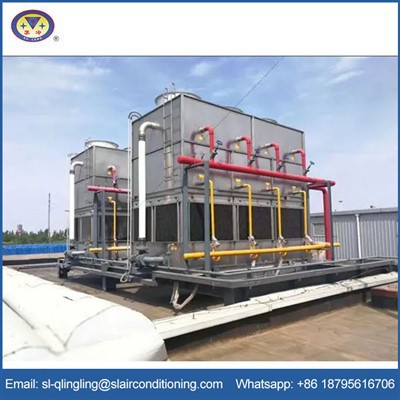
As a seasoned supplier of evaporative condensers, I've often encountered inquiries about the optimal air flow rate for these critical industrial components. The air flow rate significantly influences the performance, efficiency, and overall effectiveness of evaporative condensers, which means it's fundamental to understand the ideal parameters.
Understanding Evaporative Condensers
Before we delve into the air flow rate, it's essential to understand what evaporative condensers are and how they operate. An evaporative condenser is a heat rejection device that eliminates heat by combining the principles of both air-cooled and water-cooled condensers. It removes heat from the refrigerant by using water evaporation and air flow. When hot refrigerant gas enters the condenser coils, it transfers heat to the water flowing over the coils' surface. A portion of the water evaporates, facilitated by the air flowing through the condenser, and effectively removes heat from the system.
Importance of Air Flow Rate
The air flow rate in an evaporative condenser is a primary driver of heat transfer efficiency. A proper air flow rate ensures that enough fresh air reaches the condenser coils to carry away the moisture and heat generated by the evaporation process. This not only helps in maintaining a stable temperature inside the condenser but also ensures the continuous operation of the refrigeration or cooling system connected to it.
If the air flow rate is too low, the heat transfer process will slow down. The heat and moisture will accumulate around the coils, reducing the efficiency of the condenser. This can lead to higher refrigerant pressures, increased energy consumption by the compressor, and potentially cause system failures over time. On the other hand, an excessively high air flow rate can also be problematic. It can cause the water to be blown away before it has a chance to fully evaporate, leading to water wastage and also reducing the overall efficiency of the condenser.
Factors Influencing the Required Air Flow Rate
To determine the exact air flow rate required for an evaporative condenser, you need to consider several factors:
-
Heat Load: The amount of heat that the condenser needs to reject is a top determinant of the air flow rate. Higher heat loads demand higher air flow rates, as more air is required to carry away the heat generated. This heat load is dependent on the specific application, such as the size of the refrigeration system, the type of refrigerant used, and the operating conditions.


-
Ambient Conditions: The temperature, humidity, and air pressure of the surrounding environment play a significant role in the required air flow rate. In hot and humid climates, more air is needed to assist in the evaporation process and shed heat. Conversely, in cooler and drier conditions, a lower air flow rate may suffice.
-
Condenser Design: The design features of the evaporative condenser, such as the size and configuration of the coils, the type of fill material used, and the fan design, all impact the air flow requirements. Larger condensers or those with more intricate coil designs may need a higher air flow rate to ensure uniform heat transfer.
-
Water Flow Rate: The rate at which water is circulated through the condenser is also related to the air flow rate. A balanced water and air flow is crucial for optimal performance. If the water flow rate is high, a higher air flow rate will be needed to evaporate the excess water.
Calculating the Air Flow Rate
Calculating the exact air flow rate is a complex process that requires a detailed analysis of the factors mentioned above. Typically, engineers use computational fluid dynamics (CFD) simulations or reference to industry standards and guidelines. There are also some empirical formulas based on the heat transfer principles and the properties of the materials involved.
One basic formula to estimate the air flow rate can be derived from the heat transfer equation:
[Q = m_{air} \times Cp_{air} \times \Delta T]
Where (Q) is the heat load (in watts), (m_{air}) is the mass flow rate of air (in kg/s), (Cp_{air}) is the specific heat capacity of air (approximately 1005 J/(kg·K)), and (\Delta T) is the temperature difference between the inlet and outlet air.
However, this is a simplified approach, and in real-world applications, more sophisticated methods are often employed to account for all the variables.
Our Solutions as a Supplier
As an evaporative condenser supplier, we understand the importance of getting the air flow rate right. We offer a range of products designed to meet different air flow requirements. Our Condenser Water Treatment System ensures that the water used in the condenser is of high quality, which can improve the efficiency of the evaporation process and reduce the strain on the air flow system.
Our Single Room Evaporative Condenser is specifically designed for smaller applications where space may be limited. It is optimized to provide the right air flow rate for a single room or small-scale refrigeration needs.
For larger industrial applications, our Water Cooled Refrigeration Condenser can handle high heat loads with an appropriate air flow rate. These condensers are engineered with advanced fan designs and coil configurations to ensure efficient heat transfer.
Contact Us for Optimal Solutions
Selecting the right evaporative condenser with the appropriate air flow rate is crucial for the success of your refrigeration or cooling system. Our team of experts is ready to assist you in determining the exact requirements for your specific application. Whether it's a small-scale project or a large industrial installation, we have the knowledge and experience to provide you with the best solutions.
If you're interested in learning more about our products or need help in calculating the air flow rate for your evaporative condenser, please don't hesitate to reach out. We're here to support you in making informed decisions and ensuring the long - term efficiency of your system.
References
- ASHRAE Handbook - HVAC Systems and Equipment. American Society of Heating, Refrigerating and Air - Conditioning Engineers.
- Incropera, F. P., & DeWitt, D. P. (2002). Fundamentals of Heat and Mass Transfer. John Wiley & Sons.