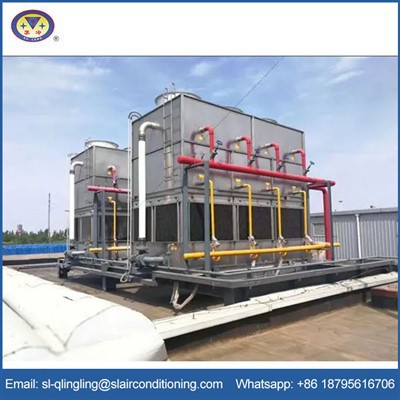
In the realm of industrial refrigeration and heat exchange systems, condensers play a pivotal role in facilitating the transfer of heat and maintaining optimal operating conditions. Among the various types of condensers available, evaporative condensers and water - cooled condensers are two popular choices, each with its own distinct characteristics and applications. As a supplier of evaporative condensers, I have witnessed firsthand the unique advantages and differences between these two types of condensers. In this blog post, I will delve into the details of evaporative condensers and water - cooled condensers, exploring their working principles, efficiency, cost, and environmental impact.
Working Principles
Evaporative Condensers
Evaporative condensers combine the functions of a condenser and a cooling tower in a single unit. The basic working principle involves the refrigerant vapor entering the condenser coils. As air is drawn through the unit by a fan, water is sprayed over the condenser coils. The heat from the refrigerant causes the water on the coils to evaporate. This evaporation process absorbs a large amount of latent heat from the refrigerant, causing it to condense back into a liquid state. The evaporated water is carried away by the air, and the remaining water is recirculated through the system. The continuous cycle of evaporation and heat transfer effectively removes heat from the refrigerant.
Water - Cooled Condensers
Water - cooled condensers use water as the cooling medium to remove heat from the refrigerant. The refrigerant vapor flows through the condenser tubes, while cooling water flows around the tubes in the opposite direction (counter - flow arrangement is common for better heat transfer). Heat is transferred from the hot refrigerant to the cooler water through the tube walls. The heated water is then typically sent to a cooling tower, where it is cooled by evaporation and then recirculated back to the condenser. This process continuously removes heat from the refrigerant, allowing it to condense.
Efficiency
Heat Transfer Efficiency
Evaporative condensers generally have higher heat transfer coefficients compared to water - cooled condensers. The evaporation process in evaporative condensers is very effective at removing heat because a large amount of latent heat is absorbed during the phase change of water from liquid to vapor. This means that for a given heat load, evaporative condensers can be more compact in size compared to water - cooled condensers.
On the other hand, water - cooled condensers rely mainly on sensible heat transfer (heating the water without changing its phase). Although counter - flow arrangements can enhance heat transfer, the overall heat transfer efficiency is typically lower than that of evaporative condensers.
Energy Efficiency
In terms of energy consumption, evaporative condensers can be more energy - efficient in certain applications. The fans used in evaporative condensers generally consume less power compared to the pumps and cooling towers required for water - cooled condensers. Since the evaporation process is so effective at removing heat, the compressor in the refrigeration system may also operate more efficiently, resulting in lower overall energy consumption.
However, water - cooled condensers may be more suitable in applications where the ambient air temperature is very high. In such cases, the performance of evaporative condensers may degrade due to the reduced evaporation rate, while water - cooled condensers can maintain relatively stable performance as long as a sufficient supply of cooling water is available.
Cost
Initial Cost
The initial cost of an evaporative condenser is usually lower than that of a water - cooled condenser system. Evaporative condensers are self - contained units that combine the functions of a condenser and a cooling tower, eliminating the need for a separate cooling tower and associated piping. This simplifies the installation process and reduces the overall equipment cost.
Water - cooled condensers, on the other hand, require a cooling tower, pumps, and a more complex piping system. The additional equipment and installation costs can make the initial investment for a water - cooled condenser system significantly higher.

Operating Cost
The operating cost of an evaporative condenser is mainly associated with water consumption and fan power. Water is continuously lost through evaporation, and makeup water needs to be added to the system. However, the energy consumption of the fans is relatively low.
For water - cooled condensers, the operating cost includes the cost of pumping water through the system and the cost of operating the cooling tower. Additionally, water treatment is often required to prevent scaling and corrosion in the condenser tubes and cooling tower, which adds to the operating cost.
Environmental Impact
Water Consumption
Evaporative condensers consume a significant amount of water through the evaporation process. However, compared to water - cooled condensers, the overall water consumption may be lower in some cases. This is because water - cooled condensers require a large amount of water to be circulated through the system, and a portion of this water is lost through evaporation in the cooling tower as well as through blowdown (to remove impurities).
Air Pollution
Evaporative condensers do not emit any significant air pollutants. The air that is discharged from the unit mainly contains water vapor. Water - cooled condensers also do not emit air pollutants directly, but the cooling towers may generate aerosols that can potentially carry bacteria and other contaminants if not properly maintained.
Applications
Evaporative Condensers
Evaporative condensers are well - suited for applications where space is limited and energy efficiency is a priority. They are commonly used in industrial refrigeration systems, such as cold storage facilities, food processing plants, and chemical plants. The high heat transfer efficiency and compact design make them an ideal choice for these applications. You can find more information about our Condenser for Water Cooler.

Water - Cooled Condensers
Water - cooled condensers are often used in large - scale commercial and industrial applications where a large amount of heat needs to be removed. They are commonly found in power plants, refineries, and large air - conditioning systems. The ability to handle high heat loads and maintain stable performance in high - temperature environments makes them a popular choice for these applications. Check out our Industrial Water Condenser and Water Cooled Refrigeration Condenser for more details.

Conclusion
In conclusion, both evaporative condensers and water - cooled condensers have their own advantages and disadvantages. Evaporative condensers offer higher heat transfer efficiency, lower initial cost, and potentially lower energy consumption in some applications. They are also more compact and suitable for space - constrained environments. Water - cooled condensers, on the other hand, are better suited for large - scale applications and can maintain stable performance in high - temperature conditions.
As a supplier of evaporative condensers, I understand the importance of choosing the right condenser for your specific application. Our team of experts can help you evaluate your requirements and determine whether an evaporative condenser or a water - cooled condenser is the best fit for your project. If you are interested in learning more about our evaporative condensers or have any questions regarding condenser selection, please feel free to contact us for a detailed consultation. We look forward to working with you to find the most efficient and cost - effective cooling solution for your needs.
References
- ASHRAE Handbook - HVAC Systems and Equipment. American Society of Heating, Refrigerating and Air - Conditioning Engineers.
- Stoecker, W. F., & Jones, J. W. (1982). Refrigeration and Air Conditioning. McGraw - Hill.