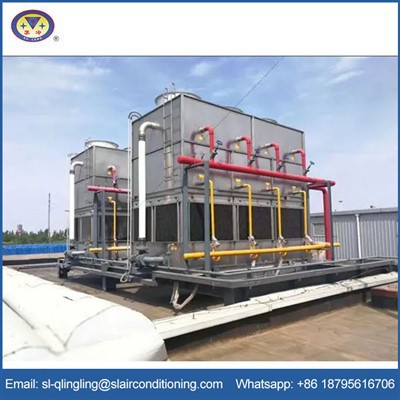
When it comes to choosing between industrial water condensers and air condensers for various industrial applications, it's a decision that can significantly impact efficiency, cost, and sustainability. As a supplier of Industrial Water Condenser, I've seen firsthand the benefits and drawbacks of both types. In this blog, I'll break down the key factors to consider when making this important choice.
How They Work
Let's start with the basics. Air condensers use ambient air to cool the refrigerant, which condenses it from a gas to a liquid state. They're relatively simple in design, with fans blowing air over the condenser coils to dissipate heat. On the other hand, industrial water condensers use water as the cooling medium. Water is circulated through the condenser coils, absorbing heat from the refrigerant and carrying it away.
Efficiency
One of the most important factors in choosing a condenser is efficiency, and here, industrial water condensers often have the edge. Water has a much higher heat transfer coefficient than air, which means it can absorb and carry away heat more effectively. This results in lower condensing temperatures and higher system efficiency. In many industrial settings, where large amounts of heat need to be removed, water condensers can significantly reduce energy consumption and operating costs.
For instance, in a large-scale manufacturing plant, an Industrial Water Condenser can handle the high heat loads more efficiently than an air condenser. The ability to maintain lower condensing temperatures allows the refrigeration system to operate at optimal conditions, reducing the workload on the compressor and saving energy.
However, air condensers have their own efficiency advantages in certain situations. They're ideal for applications where water is scarce or expensive, as they don't require a continuous supply of water. In some remote locations or areas with water restrictions, air condensers may be the only viable option. Additionally, air condensers can be more efficient in cooler climates, where the ambient air temperature is low enough to provide sufficient cooling without the need for additional energy to pump and cool water.
Cost
Cost is another crucial consideration. The initial installation cost of an industrial water condenser is generally higher than that of an air condenser. Water condensers require a complex infrastructure, including a water source, piping, pumps, and a water treatment system to prevent corrosion and scaling. These additional components add to the upfront cost.
On the other hand, the operating cost of an air condenser can be higher in the long run. Air condensers rely on fans to move large volumes of air, which consumes a significant amount of electricity. In some high-temperature environments, air condensers may need to run continuously at high speeds, leading to increased energy bills. Industrial water condensers, while having a higher initial cost, can offer lower operating costs due to their higher efficiency. Over time, the energy savings can offset the initial investment.
Environmental Impact
In today's world, environmental impact is an important factor for many businesses. Industrial water condensers, while efficient, can have a significant water footprint. They require a continuous supply of water, which can be a concern in areas with water scarcity. Additionally, the water used in condensers often needs to be treated to prevent environmental contamination before it's discharged.
Air condensers, on the other hand, have a much lower water footprint since they don't use water for cooling. They're a more environmentally friendly option in terms of water usage. However, they do contribute to energy consumption, which has its own environmental implications. To mitigate this, modern air condensers are being designed to be more energy-efficient, using advanced fan technology and smart controls.
Maintenance
Maintenance is an aspect that can't be overlooked. Industrial water condensers require regular maintenance to ensure proper operation. The water treatment system needs to be monitored and adjusted regularly to prevent corrosion and scaling in the condenser coils. The pumps and piping also need to be inspected for leaks and wear. Additionally, the water source needs to be protected from contaminants to avoid blockages in the condenser.


Air condensers are generally easier to maintain. They have fewer components compared to water condensers, and the main maintenance task is to keep the condenser coils clean. Dust and debris can accumulate on the coils over time, reducing their efficiency. Regular cleaning of the coils and inspection of the fans can ensure optimal performance.
Applications
The choice between industrial water condensers and air condensers also depends on the specific application. For industrial processes that generate large amounts of heat, such as chemical manufacturing, food processing, and power generation, industrial water condensers are often the preferred choice. They can handle the high heat loads and maintain stable operating conditions.
In applications where space is limited or where water is not readily available, air condensers are a better fit. They're commonly used in small-scale refrigeration systems, such as in commercial kitchens and refrigerated storage units.
For example, an ammonia refrigeration system in a large food processing plant may benefit from an Ammonia Refrigerating Condenser, which can be a type of industrial water condenser. The system requires efficient heat removal to maintain the low temperatures needed for food preservation.
Making the Right Choice
So, which is better, industrial water condensers or air condensers? The answer isn't straightforward. It depends on a variety of factors, including the specific application, available resources, budget, and environmental considerations.
If you're in an industry that requires high heat removal efficiency, has access to a reliable water source, and can afford the initial investment, an industrial water condenser may be the best choice. On the other hand, if water is scarce, space is limited, or the heat load is relatively low, an air condenser may be more suitable.
As a supplier of Industrial Water Condenser, I'm here to help you make an informed decision. Our team of experts can assess your specific needs and recommend the most appropriate condenser solution for your business. Whether you're looking for a Water Cooled Refrigeration Condenser or an air condenser, we can provide you with high-quality products and excellent service.
If you're interested in learning more about our industrial water condensers or need help in choosing the right condenser for your application, don't hesitate to reach out. We're ready to discuss your requirements and help you find the best solution for your business. Let's work together to improve your industrial processes and achieve greater efficiency and cost savings.
References
- Incropera, F. P., DeWitt, D. P., Bergman, T. L., & Lavine, A. S. (2007). Fundamentals of Heat and Mass Transfer. Wiley.
- ASHRAE Handbook: Refrigeration. (2019). American Society of Heating, Refrigerating and Air-Conditioning Engineers.